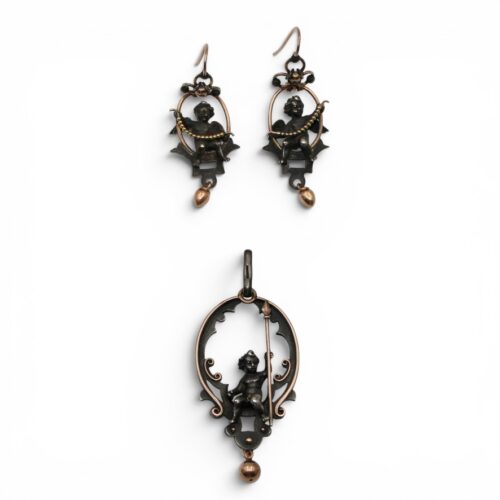
During the 19th century, archaeological discoveries in Italy, particularly in the ancient Etruscan cities, sparked a widespread fascination with antiquity. In Rome and Florence, several jewelry houses drew inspiration from the jewels unearthed during these excavations, giving rise to what is now known as the Etruscan Revival movement. Among the most renowned workshops were those of Castellani, Marchesini, and Perret, whose craftsmen faithfully revived the ancient techniques of Etruscan goldsmithing, especially granulation and filigree, while adapting them to the tastes of the nineteenth century.
These jewels often combined authentic archaeological elements—ancient coins, cameos, intaglios, and antique fragments—with contemporary gold mounts created by Italian jewelers. Blending archaeology, collecting, and artistic creation, this approach proved immensely popular among the European aristocracy and Grand Tour travelers. The jewelry produced during this period reflects a profound fascination with the ancient world and helped establish Rome and Florence as leading centers of the archaeological revival in nineteenth-century jewelry design.
Marchesini
Showing the single result